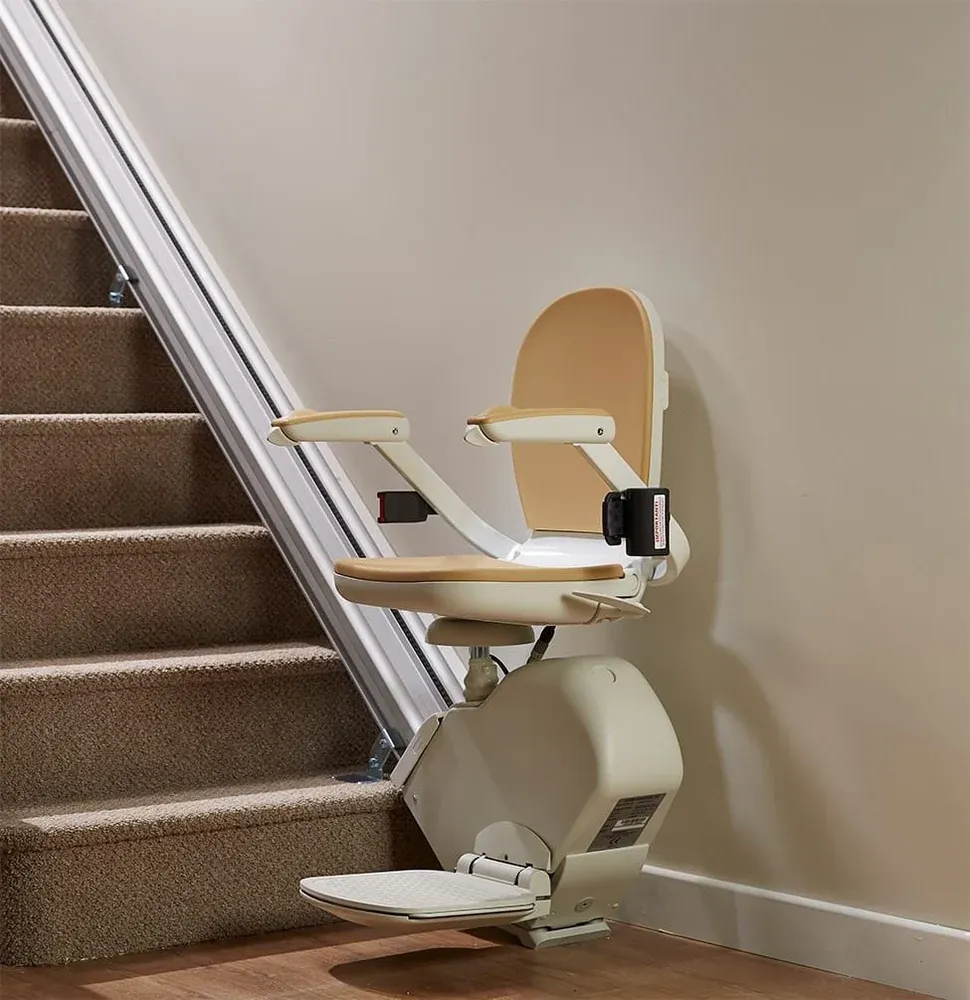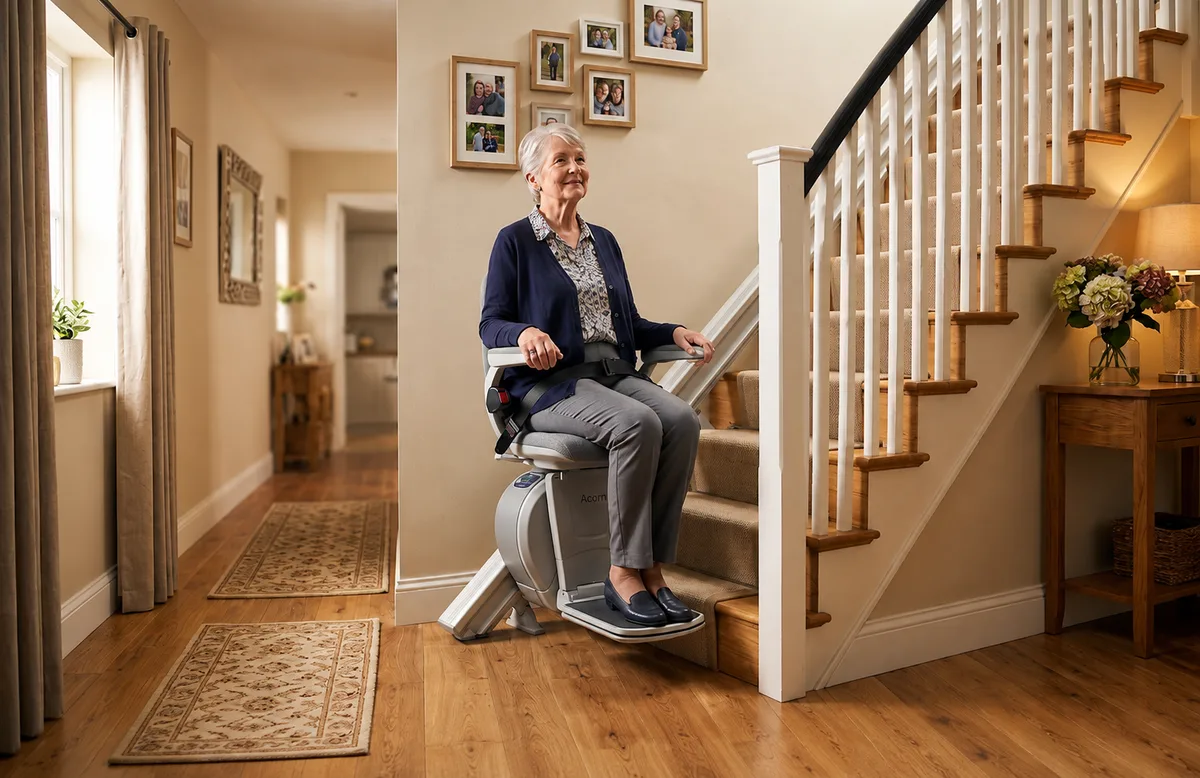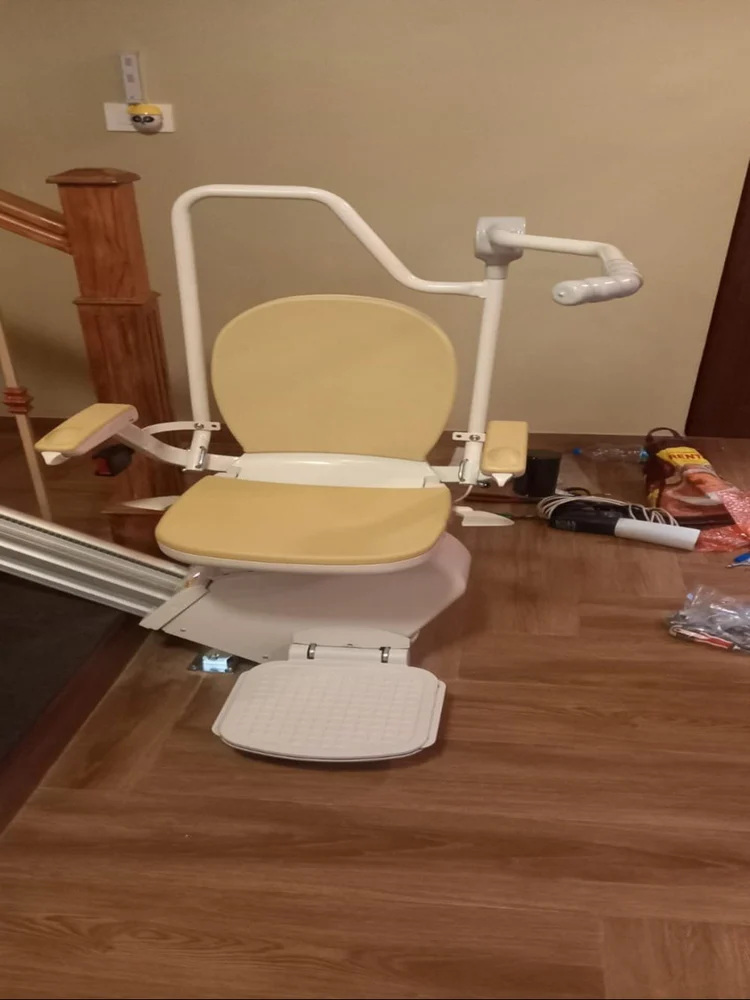
- Straight stair lifts run $2,800–$5,500 installed; standing/perch lifts run $4,500–$6,500.
- The $1,500–$2,000 gap pays for a safety harness, perch seat, and narrower rail engineering — not a "curved" staircase.
- Both types are built for straight staircases with no bends or landings.
- Standing lifts can fit staircases as narrow as 24 inches, versus a 28-inch minimum for most seated lifts.
- Standing lifts are often recommended after a hip or knee replacement, since they avoid deep bending.
- Both come with the same installer warranty, and both install in a single visit.
How Much More Does a Standing Stair Lift Cost Than a Straight One?
A standing stair lift costs about $1,500–$2,000 more than a straight seated lift, with the gap driven by engineering, not by staircase shape. Both lift types are designed for the same kind of staircase — a straight run with no turns or landings — so the price difference comes entirely from what's built into the unit itself. Every lift we sell or rent includes professional stair lift installation by our own certified technicians.
| Factor | Straight Seated Lift | Standing / Perch Lift |
|---|---|---|
| Installed price | $2,800 – $5,500 | $4,500 – $6,500 |
| Riding position | Fully seated | Semi-standing, leaning against a padded perch |
| Minimum staircase width | ~28 inches | As narrow as 24 inches |
| Best for | No difficulty bending or sitting | Stiff knees/hips, narrow stairs, post-surgery bending limits |
| Install time | Typically 2–4 hours | Typically 2–4 hours |
| Safety harness | Seatbelt | Full-body harness + grab rail |
Figures reflect typical Pennsylvania and New Jersey pricing and vary by staircase length and model. Ask for an itemized quote for an exact number. See our full stair lift cost guide for price ranges across every type we offer.
Why Is a Standing Stair Lift More Expensive Than a Straight One?
A standing stair lift costs more because it's a different piece of engineering, not a fancier version of the same one. Three specific components drive the extra cost:
- The safety harness system. A seated lift uses a simple lap belt. A standing lift needs a padded, full-body harness that fastens and releases with one hand, since the rider isn't held in place by gravity and a seat the way a seated rider is.
- The narrower rail and mechanism. To fit staircases as narrow as 24 inches — versus roughly 28 inches for a seated unit — the rail, carriage, and folding mechanism all have to be engineered tighter, which costs more to manufacture and install than a standard-width rail.
- The compact fold system. The perch seat and armrests fold flatter against the rail than a standard seat does, so more of the staircase stays clear for other household members. That folding hardware is additional engineering a straight seated lift doesn't need.
None of this is about the staircase being harder to install on — both lift types go on a straight run of stairs. The cost gap is entirely about what the chair itself has to do.
Not sure which one fits your stairs and your budget?
Get My Exact Price →What Do You Get for the Extra $1,500–$2,000?
The extra cost of a standing lift buys you a unit that solves problems a seated lift physically cannot — narrower stairs and limited bending — not extra luxury. Here's what's actually included at the higher price point:
- Fits staircases too narrow for a seated lift. If your stairs measure under 28 inches wide, a seated unit may not fit at all; a standing lift can often be installed down to 24 inches.
- No deep knee or hip bending required. You lean into the perch rather than lowering into a seat, which matters if a surgeon has restricted how far you can bend.
- A full safety harness, not just a belt. The harness wraps around the body and works even if your grip strength is limited, with obstruction sensors and battery backup included as standard on both types.
- A narrower footprint at rest. The folded unit leaves more of the staircase clear for other people in the household to use normally.
Which One Is Right for Your Staircase and Your Needs?
Choose a standing lift if bending or staircase width is the obstacle; choose a straight seated lift if neither is a problem, since it does the same job for $1,500–$2,000 less.
A standing lift usually wins if:
- Fully sitting down and standing back up is difficult or painful
- You have a hip or knee replacement with a restricted bending angle
- Your staircase is narrower than about 28 inches
- You need a temporary solution during recovery and don't want to buy new stairs' worth of clearance
A straight seated lift usually wins if:
- You have no difficulty bending or sitting comfortably
- Your staircase is a standard width (28 inches or more)
- You want the lowest-cost option that still meets your needs
- You'd prefer the more familiar, fully-seated riding position
Both are built specifically for straight staircases — neither type requires or supports a turn, bend, or landing partway up. If your stairs do have a turn, talk to a specialist about your options during a free assessment rather than assuming either type will fit.
Is the Price Gap Worth It for a Narrow Staircase?
Yes, if a seated lift genuinely won't fit — at that point, the standing lift isn't a premium option, it's the only option that works. Most seated stair lifts need roughly 28 inches of clear staircase width to operate safely alongside normal foot traffic. Many older homes, especially rowhomes and older PA and NJ builds, have staircases narrower than that. A standing lift's tighter rail and mechanism can often be installed on stairs as narrow as 24 inches, which turns a "we can't help you" situation into a working solution — at a real but justified premium.
If you're not sure whether your staircase qualifies for a seated lift, don't guess from a tape measure alone — stair width, headroom, and the newel post at the bottom of the stairs all factor into what will actually fit. A specialist measuring your stairs in person during a free assessment can tell you definitively which type will work.
How Do Installation Time and Warranty Compare?
Both types install in about the same time and carry the same warranty — the extra cost of a standing lift doesn't buy you faster installation or better coverage, just a different mechanism. Both a straight and a standing lift typically install in 2–4 hours in a single visit, and every lift we install comes with the same 2-year parts warranty, 1-year labor warranty, and after-hours emergency support. See our full stair lift installation cost & hidden fees guide for exactly what's included.
Frequently Asked Questions
-
Standing lifts cost more because they need a full-body safety harness, a narrower rail engineered to fit tighter staircases, and a more compact folding mechanism than a standard seated lift. The price difference reflects that added engineering, not a difference in staircase difficulty — both types are built for straight staircases.
-
Yes. Most seated stair lifts need a staircase roughly 28 inches wide, while a standing lift can often be installed on stairs as narrow as 24 inches. A specialist will measure your exact staircase during a free home assessment to confirm what's possible.
-
Often, yes — the leaning position keeps the hip or knee at a safer angle than fully sitting down and standing back up. Always confirm your specific bending restrictions with your surgeon or physiotherapist before choosing between a standing and seated lift.
-
Yes. Every lift The Stairlift Company installs, standing or straight, comes with the same 2-year parts warranty and 1-year labor warranty, plus after-hours emergency support.
-
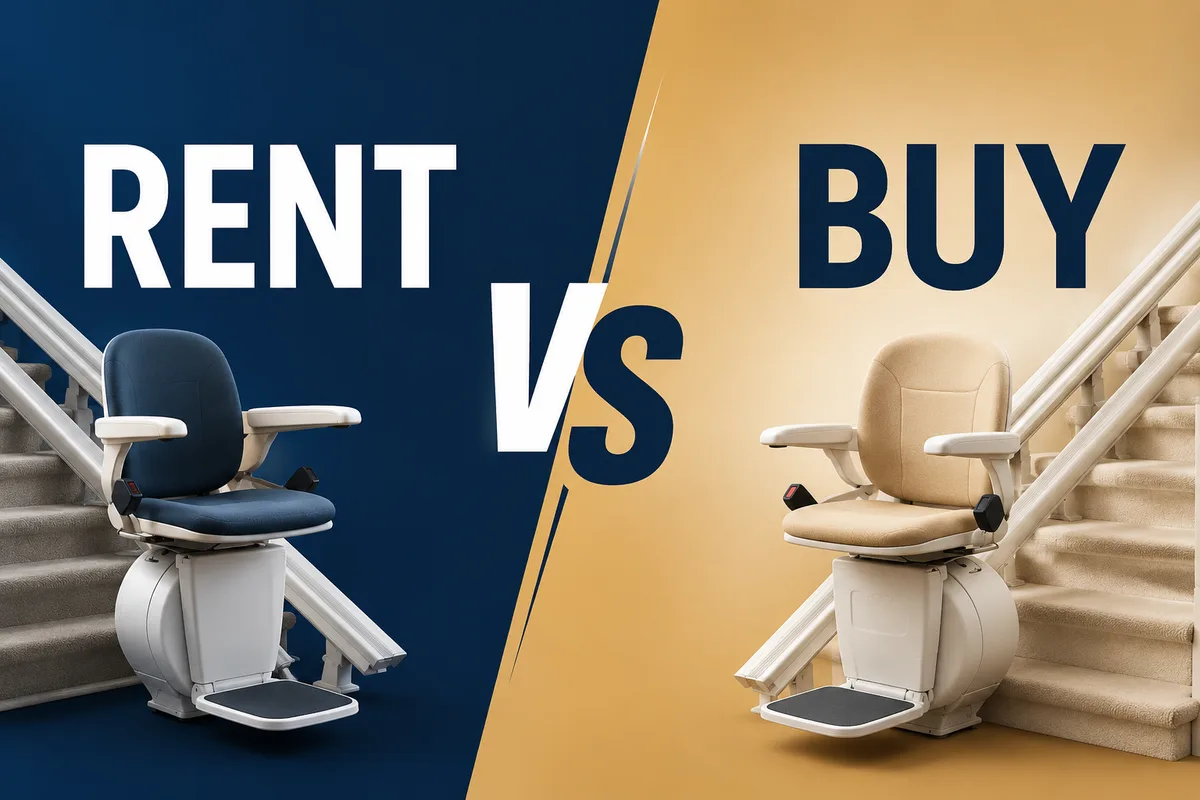
Rentals are typically available for straight seated lifts for short-term recovery needs; ask your installer whether a standing unit is available to rent in your area, since inventory for perch lifts is more limited than for standard seated units. See our full stair lift rent vs. buy comparison for the cost breakdown either way.
-
A straight seated lift is cheaper, typically by $1,500–$2,000, and is the better choice if you don't have difficulty bending or sitting and your staircase is a standard width. A standing lift only costs more because it solves a specific problem a seated lift can't — narrow stairs or limited bending — not because it's a premium upgrade.